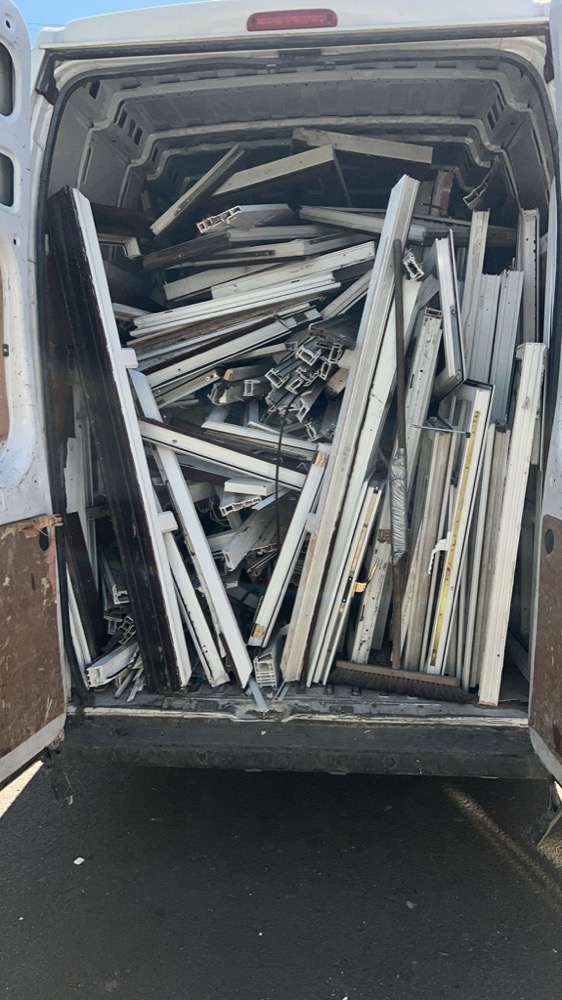
When a customer hands us a load of old window frames, it doesn't end up in landfill. It doesn't get incinerated. It doesn't disappear into a vague "recycled" black box. The journey from a removed frame to a brand-new uPVC product is a real, well-established industrial process — and it's worth understanding, both because it's interesting and because it's the reason your scrap has value in the first place.
Here's what actually happens.
uPVC is one of the most recyclable plastics
Independent industry research has shown that uPVC can be mechanically recycled up to ten times without significant loss of performance. That's a remarkable property — most plastics degrade quickly through reprocessing cycles. uPVC, by contrast, can keep going through the loop for decades.
That recyclability is the foundation of the scrap market. If uPVC ended up as landfill-only material, no one would pay you for it. The reason it has value is that there's a downstream industry willing to buy the recycled output, because that recycled output goes back into manufacturing.
Step 1: Collection and consolidation
It starts with us — or another scrap operator like us. Frames, doors, offcuts and conservatory sections come in from installers, fabricators, demolition firms and homeowners. We grade and consolidate the material at our yard, separating obvious contamination and stockpiling until there's enough for a full HGV load to a recycling facility.
This consolidation step matters. The recycling plants are large, capital-intensive operations that need consistent input volumes. Without intermediate consolidators, only the largest waste producers could feed material in directly.
Step 2: Sorting and grading at the recycling facility
At the recycling plant, the material is graded by colour and condition. White goes one way, coloured frames another, and contaminated or particularly damaged loads are routed for additional processing. This stage often involves both manual sorting and automated optical sorting equipment that can identify materials by spectral signature.
Reinforcement steel is removed — every uPVC window frame has a steel insert running through the chambers for structural rigidity, and that steel is itself recycled separately as scrap metal.
Step 3: Shredding
Sorted frames go through industrial shredders that break them down into smaller pieces — typically several centimetres across at this stage. Hardware (hinges, locks, handles), gaskets, seals and any remaining glass are separated out by a combination of magnetic, density and visual sorting.
This first shred turns a yard full of frames into something more like a pile of chunky plastic chips, ready for the next stage.
Step 4: Granulation and washing
The shredded chips are then granulated down further — to particles a few millimetres across — and run through a washing process. This removes dust, organic contamination, residual glass particles and any remaining adhesives.
The output of this stage is a clean, sorted uPVC granulate — ready to be reformed into new product.
Step 5: Pelletising
Granulate is then heated and extruded into uniform pellets. This is the form most manufacturers buy in: bags or bulk containers of recycled uPVC pellets, ready to drop into their own production lines alongside virgin uPVC.
The pellet is the trade-able unit. From here on, recycled uPVC is treated essentially the same as virgin material — it's just an input to manufacturing.
Got scrap uPVC ready to enter the recycling chain? We'll collect it for free and pay you for it. Tell us what you've got and we'll come back within the hour.
Get a quote →Step 6: New products from old frames
Recycled uPVC pellets go back into a wide range of products. Common end uses include:
- New window and door profiles. Modern uPVC profile manufacturers use co-extrusion processes that put recycled material in the inner core of the profile, with virgin uPVC on the visible outer surfaces. The result is a frame that's structurally identical to a fully virgin one but with a much lower environmental footprint.
- Drainage and ducting pipes. Underground drainage, electrical conduit and cable trunking — applications where the visual appearance of the material matters less than its mechanical properties.
- Building products. Cladding profiles, roofline products, fascias, soffits, trim and similar.
- Garden and outdoor products. Fence posts, decking, garden edging, planters.
- Cable insulation and sheathing. A traditional uPVC end-use that consumes substantial volumes of recycled material.
So a frame removed from a 1990s house in Manchester might come back, two years later, as part of a new conservatory in Cardiff, a stretch of underground drainage in Glasgow, or a fence post in someone's back garden in Birmingham.
The environmental case
Recycling uPVC versus producing virgin uPVC saves a substantial amount of energy and CO2. The recycled material avoids the emissions associated with crude-oil-based virgin uPVC production, and keeping uPVC in the recycling loop avoids both the landfill alternative and the methane emissions associated with degrading plastics in landfill.
It also preserves a finite resource. uPVC is ultimately derived from petrochemicals — the more we keep in circulation, the less virgin material we need to extract.
Why this matters for what you're paid
The whole price you receive for scrap uPVC traces back to this recycling chain. You're paid because the recyclers can sell pellets, the manufacturers want pellets, and there's a working market all the way through. The cleaner and better-graded your material is, the more efficiently it moves through this chain — which is why volume, condition, colour and contamination all show up in the rate you're offered.
Selling your scrap uPVC isn't just better economics than skip hire — it's keeping that material in the circular economy. The frames you removed last week are someone's new windows next year.