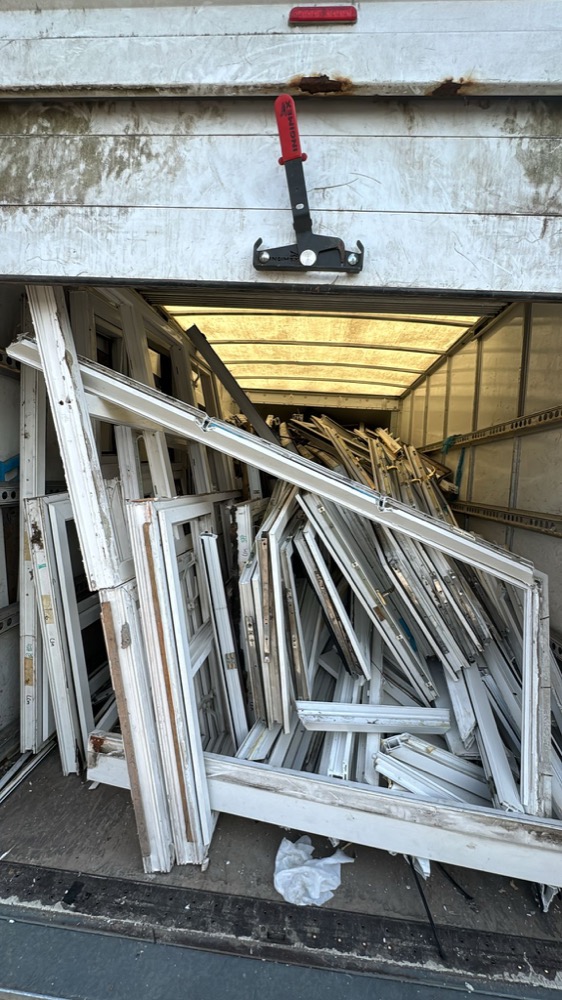
It's the question every installer asks the first time they look at a van full of removed frames and wonder whether to bother knocking the glass out before they tip them. Deglazed frames pay more per tonne — that's not in dispute. But the question isn't whether deglazing increases value; it's whether the time you spend doing it is worth more than the price uplift you get back.
Here's how to think about it.
Why deglazed frames pay more
When uPVC arrives at a recycling facility, it goes through a process: sort, shred, granulate, wash, separate. If glass is still attached, the shredder still works — but glass shards in the granulate damage downstream equipment, contaminate the output, and have to be screened out. That's an extra processing step. Frames that arrive already deglazed skip it entirely, so they're cheaper to handle and the price you're paid reflects that.
The premium varies with market conditions, but expect deglazed white frames to attract a meaningfully higher rate per tonne than glazed equivalents. For trade volumes, that gap can amount to real money over the course of a year.
When deglazing makes financial sense
You're handling regular trade volumes
If you're an installer or fabricator generating a tonne or more of frames a month, the deglazing premium adds up. At that volume, even an hour or two a week spent knocking glass out of frames pays for itself many times over. Setting up a routine — a designated bay, a glass bin, one person on it for an afternoon a week — turns it from a chore into a revenue stream.
The frames are already damaged
If the glass is cracked, the seals have failed, or the frames came out of the wall in pieces, the glass is often loose or already separated. In that case, deglazing is barely a job — you're just lifting the panes out. Worth doing every time.
You've got a yard or workshop with the right kit
Deglazing is fast with the right setup: a stable surface, basic hand tools, eye protection, gloves, and a wheeled bin for the glass. If you've got a yard where you can stockpile frames and run through them in batches, the per-frame time drops significantly compared to doing it on-site at every job.
When deglazing isn't worth it
You've got a one-off job
Single house, ten or twelve frames, no accumulated stockpile. The price uplift from deglazing those few frames will be modest in absolute terms, and the time spent doing it (plus disposing of the glass safely) probably costs more than you'd gain. Sell them glazed, take the slightly lower rate, get on with the next job.
The frames are still on-site and you're against the clock
If the customer wants the kitchen extension finished by Friday and you're squeezing the window strip-out into Thursday afternoon, deglazing is not the priority. Get the frames out, get them collected, move on.
You don't have anywhere safe for the glass
Deglazing creates a glass disposal problem. If you don't have a route for that — a glass skip on-site, a collection arrangement, somewhere it can sit safely until pickup — it's not worth starting. Glass on the ground is a hazard, in a domestic skip it's often refused, and in a regular waste stream it's a nuisance.
Whether you deglaze or not, we'll buy your frames. Tell us the condition when you request a quote and we'll price accordingly. No obligation, fast turnaround, free collection.
Get a quote →How to deglaze uPVC frames quickly
For installers who want to set up a routine, here's the basic process:
- Lay the frame flat. A trestle table, pallet, or sturdy bench. Don't try to deglaze a frame standing upright — it's slower and more dangerous.
- Remove the glazing beads. A plastic glazing knife or wide flat-blade screwdriver. Pop them out from the inside edge. Save the beads for scrap if you can — they're uPVC too.
- Lift the unit out. Sealed units are heavy — get a hand if you need one. Set them in a glass bin or stack them flat for collection.
- Strip the gasket. Pull the rubber gasket out of the channel. Most yards will accept it on the frame, but cleaner frames pay better.
- Stack and store. Nest the empty frames flat. They take up far less space deglazed than glazed.
What to do with the glass
Sealed double-glazed units are recyclable, but the recycling chain for them is more limited than uPVC. Options:
- Specialist glass recycler. Trade glass merchants will often take old units, especially clear glass. Some pay, most don't, but they'll usually take them off your hands free.
- Local council waste site. Most household waste recycling centres accept glazing, but check the rules first — some require trade-waste accounts.
- Skip with the rest of the job's waste. Practical if you're already running a skip on the project.
The bottom line
Deglaze when you've got the volume, the time, the space, and a route for the glass. Skip it when you're doing a one-off house and just want the frames out of the way. Either way, the material has value — don't let "we should have deglazed" stop you from selling glazed frames if that's where you've ended up.
Tell us what you've got, in whatever condition, and we'll quote it.