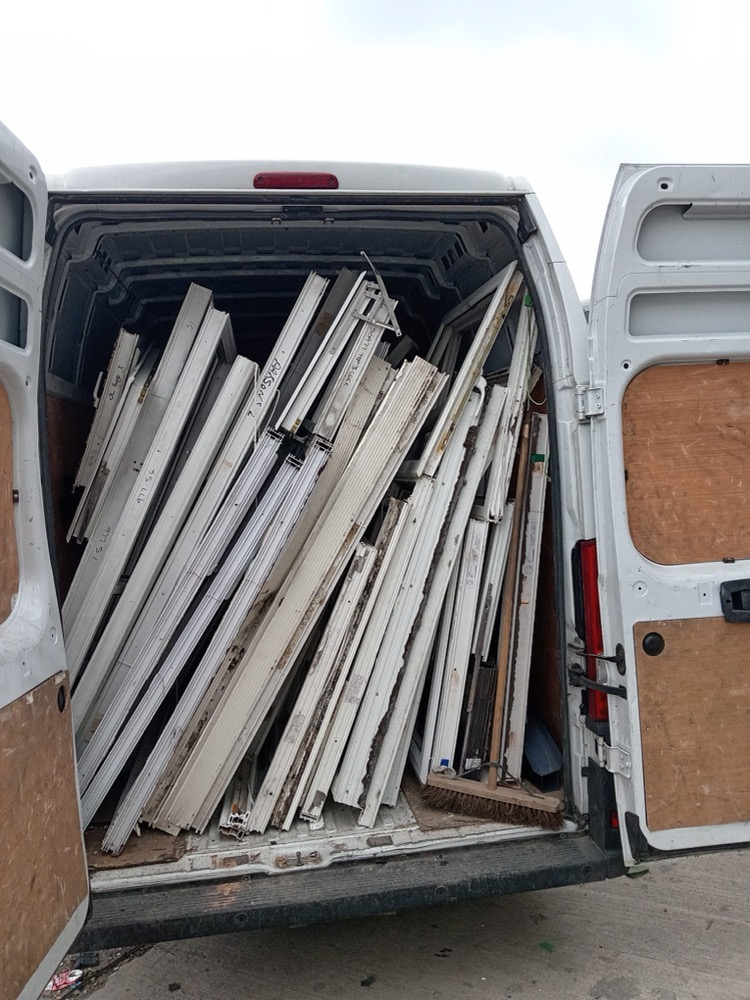
Most installers and homeowners reach the same default conclusion when they need to get rid of old uPVC window frames: hire a skip. It's the obvious move. Skip turns up, frames go in, skip leaves. Job done.
The trouble is, that obvious move is also the most expensive option on the table. Let's do the maths.
The cost of a skip for uPVC frames
Skip hire prices vary by region and skip size, but for a typical uPVC strip-out you're looking at:
- 4-yard skip (mini) — around £180–£260, suitable for a small house worth of frames
- 6-yard skip (midi) — around £230–£340, suitable for an average detached house or small commercial job
- 8-yard skip (builder) — around £280–£420, suitable for larger residential or small-scale commercial
Add to that any of the following, depending on the job:
- Permit costs if the skip goes on the road — typically £30–£80 from the local council, plus permit-only delivery fees from the supplier
- Weight surcharges — most skip companies have weight limits, and uPVC frames with steel reinforcement and glass can hit those limits surprisingly fast
- Wait-and-load fees — if you can't have the skip on-site overnight, charges apply
- Mixed-waste premium — if the skip contains anything outside the standard mixed-waste classification
For a typical residential window strip-out, you're realistically looking at £250–£400 all-in by the time you've covered everything.
The cost of selling for scrap
The scrap option costs nothing. We come to your property, depot or site, and collect the material at no charge. There's no skip fee, no permit, no weight surcharge.
On top of that, we pay you for the material. The amount depends on volume and condition — a single house's worth of frames will earn you a smaller payment than a tonne of fabricator offcuts — but you'll always be in net positive territory rather than out of pocket.
The maths a typical installer is missing
Take a working installer who fits 4 sets of windows a month, replacing the old frames with new. That's roughly:
- 4 × small skips a month at ~£250 each = £1,000 a month in disposal costs
- Or 4 × free collections a month earning a payment per load = income, not cost
The swing is north of £1,000 a month — £12,000 a year — between "skip every job" and "scrap every job". For a sole-trader installer, that's the difference between a meaningful margin and a disposal-cost line item that's quietly eating their take-home.
Multiply that across a regional installer with a few teams on the road and the numbers get serious fast.
Stop paying to dispose of material you should be paid for. Free collection across the North West, North Wales and Midlands. Tell us what you've got and we'll quote it.
Get a quote →Hidden costs of the skip route
Beyond the headline skip fee, there are real hidden costs:
Time managing the skip
Booking, scheduling, supervising drop-off, dealing with collection, managing access. None of it is free time — it's just unmeasured time.
Permit hassle
If the skip needs to go on the road in a residential area, you're applying for a permit, often with seven days' lead time. That's a real planning constraint on jobs.
Reputational hit
Skips on residential streets are an eyesore and a frequent complaint trigger from neighbours. Customers notice, and customers tell other customers.
Environmental impact
Material that ends up in a mixed-waste skip is often routed to landfill or low-grade recovery, even when the constituent materials (uPVC included) are individually recyclable. The scrap route keeps it in the circular economy.
The skip rejection risk
Some skip operators classify uPVC with steel reinforcement as "metal-contaminated waste" and either reject the load or apply a surcharge. It's worth checking before you book — and then realising you're filling out forms to pay extra to dispose of material someone else would pay you for.
When skip hire still makes sense
Skip hire isn't always wrong. Cases where it's the right call:
- The waste is genuinely mixed. If you're stripping out a kitchen extension and the uPVC is mixed in with timber, plasterboard, packaging and general builder's rubbish, a skip is the right tool. But the smart move is still to pull the frames out of that skip and into a separate stack for collection.
- Tiny volumes with no logistical sense in a separate collection. A single broken patio door wouldn't justify its own collection visit if a skip is already on-site.
- Sites with no access for a separate vehicle. Restricted-access jobs where logistics drive the decision.
For everything else — and "everything else" is most jobs — the scrap route is cheaper, more environmentally sound, and earns you money instead of costing it.
The bottom line
Skip hire for uPVC scrap is paying £250–£400 to dispose of material that someone else would collect for free and pay you for. For a one-off job it's a few hundred pounds. For a working installer, it's thousands a year. The maths isn't close.
If you've been on autopilot with skip hire — most people are — it's worth asking your operations manager or yourself why. Often the answer is "we've always done it this way", which is rarely a good answer for a recurring four-figure cost.
Try the scrap route once. Get a quote on whatever you've got coming up next. Compare it side by side with the skip cost. Make the call from there.