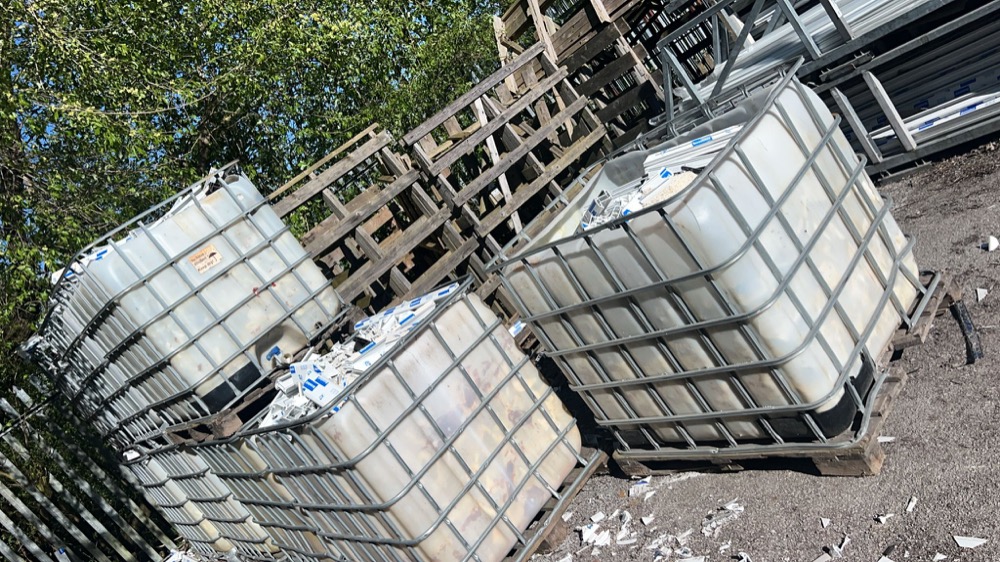
The window and fenestration industry generates more uPVC scrap per square metre of factory floor than almost any other manufacturing sector. Profile offcuts pile up in every fabrication unit. Failed welds, sash returns, customer rejects, end-of-line stock — every operation that turns extruded profile into a finished window produces waste, and that waste has commercial value.
For too many fabricators and installers, that value disappears into a skip. The aim of this guide is straightforward: to help operators in the fenestration industry treat their uPVC scrap as the revenue stream it actually is, rather than the cost line it's often filed under.
Where the scrap actually comes from
If you walk a typical fabrication unit, the uPVC scrap is hiding in five obvious places and one less obvious one.
Profile offcuts
Every cut on a saw produces an offcut. The scrap from end-trim, mitre cuts, and length adjustments accumulates fast. A unit producing 200 windows a week is generating cubic metres of profile offcuts, and most of it goes into a mixed-waste skip if no one's set up a dedicated stream for it.
Welder rejects and failed assemblies
Every fabricator has a reject pile. Misalignments, bad welds, customer specifications that came back wrong. These are typically full or partial frames — clean, fresh material in trade-friendly form factors.
Sash returns and warranty replacements
Service teams come back with frames pulled from customer properties under warranty. Often perfectly recyclable but in a confused state — boxed, half-stripped, mixed with hardware. Whether you stockpile them at the depot or strip them down depends on volume.
End-of-line stock and obsolete profile
System upgrades, colour changes, customer cancellations. Profile sat on racking that's never going to ship. Cleaner material than offcuts, often in long lengths, and at the higher end of the rate card.
Site removals on installation jobs
For installers who remove old frames as part of new installations, those removed frames are their own scrap stream — separate from factory waste, often coloured, often glazed, but still material with value.
The less obvious one: contaminated mixed-waste skips
Most fabricators are paying landfill fees on uPVC scrap that's gone into a general waste skip alongside cardboard, packaging and plastic film. Get the uPVC out of the mixed skip and into a dedicated container, and you flip a cost into a payment.
Why most fabricators leave money on the floor
The pattern we see across the industry is consistent. The waste stream isn't strategically managed — it's whoever happens to be free that day filling whatever skip is closest to the cutting room. The result is:
- Mixed contamination that drops the per-tonne price
- Skip fees being paid for material that should be earning revenue
- No measurement, so the scale of the loss isn't visible at management level
- No relationship with a scrap buyer, so when there's a one-off bulk clearance there's no one to call
The solution isn't complicated. It's a dedicated container, a clear segregation rule, and a regular collection schedule.
Run a fabrication unit or installation business? We work with fenestration operations across the region on regular collections, on-site containers and bespoke trade pricing. Let's talk.
Discuss a trade arrangement →Setting up a uPVC scrap stream that works
1. Segregate at source
Put a dedicated container near the cutting saws and the welder reject point. Make it physically obvious — different colour, signage, ideally bigger than the general waste bin so the easy path is the right path. Day one is the only hard part. After a week, it becomes routine.
2. Pick the right container
For most fabrication units, an open-top stillage cage or a 6-cubic-yard skip works well. Frames and offcuts are bulky relative to their weight, so don't underestimate the volume you'll generate. We supply containers free as part of regular collection arrangements — talk to us about sizing for your output.
3. Set a collection rhythm
Weekly, fortnightly, monthly — depends on your output. The key is consistency. Don't wait until the container is overflowing and someone has to pile material on top. Schedule collections so the container is replaced before it's full.
4. Negotiate trade rates
Regular volume deserves regular rates. Rather than spot pricing every load, agree a structure: a base per-tonne rate that adjusts with market movement, payment terms (we offer same-day, weekly settlement, or monthly), and clear arrangements for irregular larger loads (warranty stockpiles, end-of-line clearances).
5. Measure it
Every collection generates a weight ticket. Track the tonnage and the revenue. Within a quarter, you'll know exactly what your uPVC scrap stream is worth — and once you know, it's much easier to defend the segregation discipline at the team level.
What we offer fenestration trade customers
For window manufacturers, fabricators, installation businesses and fenestration networks, our standard trade offering includes:
- Free on-site containers — sized to your output, refreshed on a schedule that suits your operation.
- Scheduled collections — weekly, fortnightly or monthly, with priority slots for larger one-off loads.
- Best per-tonne rates — regular trade volumes attract our highest pricing tier, and we'll match or beat any genuine competing quote.
- Flexible payment terms — same-day BACS, weekly settlement, or monthly invoice arrangements.
- Full waste transfer documentation — every collection generates compliant paperwork for your records.
- Mixed-material handling — uPVC is our specialty, but we can also collect aluminium frames in the same visit if your job mix includes them.
- A single point of contact — one account manager who knows your operation, not a call-centre rota.
Compliance and waste transfer
Anyone moving commercial waste in the UK has duty-of-care obligations. As a fully licensed waste carrier, every collection we make generates the waste transfer documentation you need on file. That covers your compliance position, demonstrates responsible disposal, and is the kind of thing that becomes important fast if you ever face a regulatory review or environmental audit.
For fenestration operators with environmental management systems (ISO 14001 or similar), our consolidated reporting can plug straight into your waste audit reporting.
Talk to us about your operation
Every fabrication unit is different. Saw setups, profile mix, glazing partnerships, installation footprint — all of it shapes what an optimal scrap arrangement looks like. We'd rather have a 15-minute conversation about your specific operation than push you into a generic package, so the best next step is to give us your details and we'll come back to walk through what makes sense for you.